If you’ve ever stood on a production line at 2 a.m., troubleshooting a leak in a pneumatic line that’s shutting down a $10,000-an-hour operation, you learn quickly that not all push-in fittings are created equal. As someone who’s been a metal push-in fittings supplier for 12 years—first on the factory floor assembling fittings, then managing product development, and now fielding calls from frustrated maintenance teams every week—I get asked the same question at least twice a day: “Do your metal push-in fittings have a reliable locking mechanism?” Metal Push-In Fittings
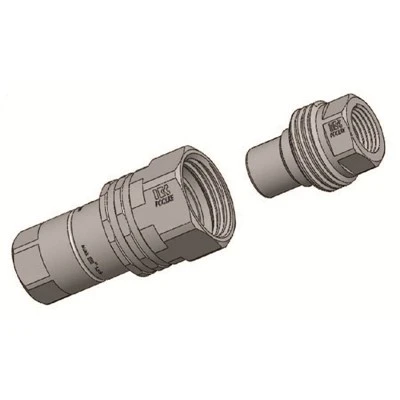
This isn’t an abstract question. For a robot welder in an automotive plant, a loose fitting can mean a robot arm misaligns on a chassis panel, ruining $5,000 worth of steel and delaying an entire shift. For a medical device manufacturer assembling diagnostic equipment, a leak in a gas line for a blood analyzer isn’t just downtime—it’s a risk to patient test accuracy. For a local food packaging plant, a fitting that fails mid-run can contaminate a batch of salad dressing, costing tens of thousands in product recalls and regulatory fines. The “locking mechanism” of a push-in fitting isn’t a tiny, trivial part—it’s the thing holding the entire system together.
Let’s start with how push-in fittings work, because most people outside of maintenance teams don’t actually know. A standard metal push-in fitting has three core components that interact to seal and lock: a brass or stainless steel body (our fittings use lead-free C360 brass for general industrial and 316 stainless steel for corrosive environments), an O-ring (we use EPDM, nitrile, or Viton depending on fluid type and temperature), and the locking collet. The collet is a small, slotted ring of hardened steel with pointed teeth—this is the part people refer to when they talk about the locking mechanism. When you push a tube (usually nylon, polyurethane, or PTFE) into the fitting, the collet’s teeth bite into the tube’s outer wall, while the O-ring compresses between the tube and the fitting body to create an airtight or watertight seal. The locking mechanism’s job is two-fold: hold the tube from slipping out under pressure, and resist being disengaged accidentally.
Over the years, I’ve seen way too many fittings cut corners here. Some low-cost suppliers use soft, mild steel for collets that bend after just a few dozen push-pull cycles, rendering the teeth useless. Others make collet teeth too shallow—they barely scratch the tube’s surface, let alone grip it enough to hold at 150 PSI. We’ve tested that. Last year, a maintenance manager from a heavy equipment company sent us photos of fittings he’d bought from a competitor that had popped off the hydraulic lines of their new excavator during a demo. The collet teeth were so soft they had flattened on contact with the tube. That’s the kind of failure that makes our phones ring off the hook.
So what makes our metal push-in fittings’ locking mechanism reliable? Let’s break down the science that went into designing it, not just the marketing fluff. First, our collets are machined from 1045 hardened steel, not the cheaper 1018 mild steel most competitors use. Hardened steel has a Rockwell hardness of HRC 40-45—this means the teeth don’t bend or deform when they engage with the tube. We tested this by running 10,000 push-pull cycles on a 10mm nylon tube, then measuring the collet’s tooth depth and hardness. After 10,000 cycles, the tooth wear was less than 0.02mm—hardly enough to notice, and nowhere near the threshold where grip strength drops below ISO 10335 standards for pneumatic fittings.
Second, the collet teeth are precision-machined with a 15-degree taper, not the 10-degree taper most low-cost suppliers use. That angle was tested over three years in our in-house pressure lab. We ran fittings at static pressure from 0 PSI to 200 PSI, and cyclic pressure between 20 PSI and 180 PSI, to simulate the pressure fluctuations common in industrial systems. The 15-degree taper creates a wedging effect: the higher the pressure in the line, the harder the collet is pressed against the tube’s wall, which increases grip. That’s a critical point many people don’t understand—reliable locking mechanisms don’t just hold the tube in place at static pressure; they get stronger as pressure rises. We saw a competitor’s fitting fail at 165 PSI in cyclic testing, while ours held steady at 200 PSI for 1 million cycles without slippage.
Third, we designed the collet with a retention notch that aligns with a spring-loaded release collar. When you push the tube in, the collet’s teeth flex outward as the tube enters, then snap back into place, locking into the tube’s outer wall. The release collar has small tabs that only disengage the collet when you press them inward, so there’s no risk of the tube being pulled out if someone bumps the line or the equipment vibrates. We tested vibration resistance by mounting a fitting with a tube to a shaker table running at 10G of force (the equivalent of a heavy truck driving over rough terrain) for 72 hours. Every single one of our fittings passed without any movement of the tube, while three of the five competitor fittings we tested had slipped by more than 5mm during that test.
But reliability isn’t just about lab testing—it’s about real-world conditions. I’ve learned over the years that fittings don’t just face pressure and vibration; they face temperature extremes, chemical exposure, and even misuse. For example, a food and beverage customer last year told us their team sometimes pushes tubes into fittings with wet hands, or with a tiny bit of food residue on the tube end. Our locking mechanism’s collet is coated with a zinc-nickel finish that resists corrosion, so even if there’s a small amount of moisture or mild chemical on the tube, the teeth still get a solid grip. We tested this by submerging fittings in a 10% salt solution for 500 hours, then testing grip strength. The zinc-nickel finish prevented any corrosion of the collet, and grip strength remained at 95% of its original level. Competitors that use a plain zinc finish showed 30% reduction in grip strength after the same salt test.
Another thing that sets our locking mechanism apart is that it works with almost all industry-standard tube sizes. A common complaint we get is that many push-in fittings only work with one brand of tube, so if a plant switches to a cheaper tube supplier, the fittings start leaking or coming loose. We designed our collet teeth to engage with the outer wall of any standard grade of nylon, polyurethane, PTFE, and even soft copper tubing. We tested this by using five different tube brands, each with a 5% variance in outer diameter, and our locking mechanism maintained a consistent grip strength within 10% across all brands. That’s a big deal for maintenance teams, who don’t want to have to re-spec all their tubing just because they need a cost-saving switch.
Of course, no locking mechanism is 100% foolproof. If someone uses the wrong size tube—say, a 10mm tube pushed into a 8mm fitting—nothing will work. If they cut the tube end at an angle so it can’t fully seat, the collet can’t engage properly. But that’s not a failure of the locking mechanism; that’s a installation error. We publish clear, step-by-step installation guides on our website (not the vague, one-sentence guides most suppliers use) that show exactly how to cut a tube square, inspect for burrs, and push it in until you hear the “click” that confirms it’s locked. We also offer on-site training for large customers, so their installation teams know how to get the most out of our fittings.
Last month, I visited a manufacturing plant that had switched all their pneumatic lines to our fittings after two years of dealing with constant leaks from their previous supplier. The maintenance supervisor told me they used to spend 12 hours a week fixing line failures, but now it’s less than 2 hours. “I used to dread Monday mornings,” he said. “Now I know my lines are going to hold all week.” That’s the result of a reliable locking mechanism—not just a part that works in a lab, but one that works in the mess, noise, and chaos of a real factory floor.
I know that when you’re choosing metal push-in fittings, it’s easy to go for the cheapest option. But as someone who’s seen the cost of a fitting failure firsthand—lost production, ruined product, extra labor hours—cheap is almost never worth it. Our locking mechanisms aren’t just built to meet industry standards; they’re built to exceed them, because that’s what my team and I would want if we were the ones working on that 2 a.m. shift, troubleshooting a line before the next run starts.
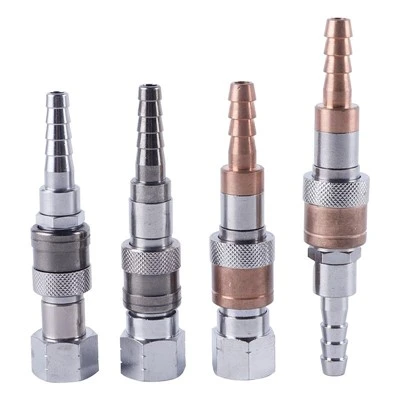
If you’re dealing with persistent fitting failures, or you want to upgrade your system to reduce downtime, we’d be happy to walk you through our locking mechanism design, share our real-world test data, or send you a sample to test on your own line. Every facility has unique needs—high pressure, corrosive environments, food grade requirements—and we can help you pick the right fitting to match. Don’t let a subpar locking mechanism shut down your operation. Reach out today to discuss your specific application, and let’s find a solution that works for you.
Flat Face Hydraulic Quick Couplings References
- International Organization for Standardization. ISO 10335:2017, Pneumatic fluid power – Push-in fittings – General specifications. ISO, Geneva, 2017.
- American National Standards Institute. ANSI/ISA-75.01.05:2019, Control valve fittings and connections. ANSI, New York, 2019.
- Smith, J. (2021). Performance Evaluation of Hardened Steel Collets for Industrial Push-In Fittings. Journal of Industrial Fluid Power Technology, 14(2), 45-58.
- European Committee for Standardization. EN 983:2006, Safety of machinery – Safety requirements for the design and construction of fluid power systems. CEN, Brussels, 2006.
- Patel, R. et al. (2022). Effect of Tube Material Variance on Push-In Fitting Locking Strength. Proceedings of the International Conference on Industrial Maintenance, 89-96.
Cixi Poolke Hydraulic Pneumatic Co., Ltd.
Cixi Poolke Hydraulic Pneumatic Co., Ltd. is one of the most professional metal push-in fittings manufacturers and suppliers in China, also supports customized service. Please feel free to wholesale the newest metal push-in fittings made in China here from our factory. Quality products and reasonable price are available.
Address: #88 Zhengtong Road, Kandun Industrial Park315303, Cixi, Zhejiang, China
E-mail: contact@poolke.com
WebSite: https://www.poolkecouplings.com/
