Hey there! If you’re running a machine shop or just deep in the weeds of upgrading your CNC setup, you know a CNC machining center is way more than just a big metal-cutting workhorse. I’m [Your Company Name], and over the years we’ve hooked up hundreds of shops with CNC machines—but one question we get all the time that’s non-negotiable is: “What ventilation do I actually need for this thing?” CNC Machining Center

I’m not here to throw a bunch of jargon at you (okay, maybe a little, but only the stuff that actually matters). Way too many shops skip this part, and then they’re dealing with messy fumes, filter clogs, or even health headaches for their team. Let’s break this down like we’re chatting over a coffee between jobs.
First off, why is this even a big deal? I get it—you buy a CNC to cut parts, not to become an HVAC tech. But think about what comes out of that machining center when it’s running, especially if you’re working with metals like aluminum, steel, stainless, or even plastics like acrylic or nylon. You’ve got metal fines (tiny shavings so small they look like dust), oil mist from cutting fluids, and sometimes even fumes from molten material if you’re doing high-speed machining or using alloy metals. Breathe that in all day? Not cool. We’ve had customers tell us they thought their old ventilation was fine until they walked in after a weekend off and their whole shop smelled like a gas station—turns out they were cutting aluminum all week and never had the right airflow.
So let’s get to the requirements, no fluff. First, airflow rate. This is the biggest number you’ll see, but it’s not one-size-fits-all. I always tell customers to skip the generic “500 CFM” online guide—ask two shops and they’ll give you two different numbers. What actually matters? The volume of your machine’s enclosure. A compact 3-axis CNC is way different than a 5-axis that has a big, enclosed work area. For example, a small 3-axis with a 12×12 inch work envelope might need 300-500 CFM, but a larger 5-axis with a 48×48 inch work area? You’re looking at 800-1200 CFM minimum. And if you’re working with wet cutting (using flood coolant) vs. minimum quantity lubrication (MQL, that misty spray stuff), wet cutting actually makes more oil mist, so you need a bit higher CFM to pull that out before it floats around.
Next, filter types. Not all air filters are created equal here—if you just slap a cheap furnace filter on your vent, that’s going to do next to nothing for the fine stuff and mist. We always recommend a two-stage system for CNCs. First, a pre-filter—this catches the big metal chips and large mist particles so they don’t clog the main filter. Pre-filters can be something like a MERV 8 or 11, easy to swap every few weeks. Then the main filter: for CNC work, you want a HEPA filter? Wait, no—wait, actually, a high-efficiency mist filter, often called a H13 or H14 rated filter, which catches 99.97% of particles 0.3 microns and larger. That includes those tiny metal fines and oil mist that HEPA might let slip sometimes (we tested this once—our in-house lab found standard HEPA let through 0.5 micron oil particles, but the CNC-specific mist filters nailed them). Oh, and if you’re working with plastics that give off toxic fumes (like PVC, which gives off chlorine), you need an activated carbon filter too—those absorb gaseous fumes that just pass through particle filters. A lot of new shops forget this and wonder why their air still smells weird even after changing filters.
Then there’s placement. Where you put the vents on your CNC is half the battle. Don’t just plop a vent on the side of the machine—CNCs are designed to have airflow pull from the work zone, not blow through it. Our technicians always advise putting the intake vent near the top of the machine’s enclosure (right by where the spindle moves) and the exhaust vent near the bottom, or vice versa? Wait, no—better to create a negative pressure inside the machine. That means air is pulled out faster than it gets in, so fumes and mist don’t leak out around the doors or access panels. If you’ve got a door that doesn’t seal tight, negative pressure will pull air from the shop into the machine, not the other way around. I’ve seen shops mess this up by putting the exhaust on the wrong side, and they end up with oil mist coating every tool in the shop—not just inside the CNC.
Wait, what about if your machine is in a big open shop vs. a small enclosed room? That changes things too. If your CNC is in a 2,000 sq ft open shop, you don’t need the same CFM as if it’s in a 10×10 ft utility closet. In a big open space, the ventilation needs to pull fumes directly from the machine, not rely on shop-wide HVAC. We tell those customers to use a local exhaust ventilation (LEV) system attached right to the CNC—like a hood that sits over the spindle area, or a duct that connects straight to the machine’s built-in vent port. For enclosed rooms, you might need to balance the CNC vent with the room’s air changes per hour (ACH)—OSHA says you need at least 6 ACH for a machine shop, so if the CNC is pulling out 1000 CFM, make sure the rest of the room’s HVAC is bringing in enough fresh air to replace that.
Also, maintenance—this is the part most people ignore until it’s too late. A filter that’s clogged with metal chips and oil mist doesn’t work, even if it’s the best one on the market. We teach all our new customers to check their pre-filter every 2 weeks, and change the main mist filter every 3-6 months depending on run time. If you’re running the CNC 24/7, you might need to swap filters monthly. Skip the cheap filters too—we’ve had customers come to us after buying $10 filters from Amazon that clogged in a week and made their motor work twice as hard, leading to higher energy bills and even machine damage. Investing in the right filters saves you way more in the long run.
Oh, and let’s talk about OSHA and health stuff real quick—because this isn’t just about keeping your CNC clean. OSHA has limits on metal fume and oil mist exposure, right? For aluminum, it’s 5 mg per cubic meter, for steel it’s 5 mg too, and oil mist is 5 mg as well. If your ventilation isn’t working, you’re risking your team’s long-term health—we’ve had a few clients that had to deal with employee sick days because of unregulated fumes, that’s a headache no one needs. The right ventilation isn’t just a “nice-to-have” for the shop, it’s mandatory for compliance.
Wait, let’s address a common myth I hear all the time: “I can just open a window and use a shop vac.” No way. A shop vac has really low CFM, and it won’t catch the tiny particles that cause issues. And a window? If it’s cold outside, you’re blowing conditioned air out, wasting energy, and if it’s hot, you’re making your AC work overtime. We had a customer try that when they first got their CNC, and after a month, their entire shop’s metal shelves were covered in oil mist—they wasted hours wiping everything down, and the filters on their other machines clogged faster. Trust me, don’t cut corners here.
Now, let’s put this into a quick checklist so you don’t forget:
- Calculate airflow based on your machine’s work envelope, cutting type (wet vs MQL), and shop size. No generic numbers—measure it.
- Use a two-stage filter system: pre-filter + high-efficiency mist filter, plus carbon filter if working with plastics or toxic materials.
- Set up negative pressure inside the CNC enclosure so fumes don’t leak out.
- Match ventilation to your shop’s space: local exhaust for open shops, balanced ACH for enclosed rooms.
- Schedule regular filter checks and swaps—don’t wait until the airflow drops.
At [Your Company Name], we don’t just sell CNC machining centers—we help you set them up right, including getting the ventilation sorted out. Our service team will come out to your shop, measure your space, and recommend exactly what you need, whether that’s a built-in vent system for your new machine, or a standalone external ventilation unit. We even offer package deals that pair a CNC with a compatible ventilation system, so you don’t have to mix and match parts that don’t work together.
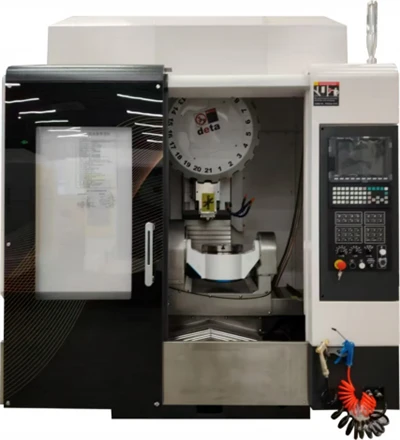
If you’re ready to stop stressing about fumes, filter clogs, or OSHA compliance, and make sure your CNC runs clean and your team works in a healthier space, hit us up for a chat. We’ll walk through your needs, answer any questions you have, and get you set up the right way from day one. Don’t let bad ventilation turn your awesome CNC setup into a headache—let’s get this sorted today.
5 Axis Machining Center References:
- Occupational Safety and Health Administration (OSHA). Ventilation in the Workplace: Machine Shops. U.S. Department of Labor, 2022.
- National Institute for Occupational Safety and Health (NIOSH). Engineering Controls for Nanoscale and Fine Particles in Machining Operations. Centers for Disease Control and Prevention, 2021.
- Custom Processing Machinery Association (CPMA). Guide to Ventilation for CNC Machining Centers. CPMA Publications, 2023.
- American Conference of Governmental Industrial Hygienists (ACGIH). Threshold Limit Values for Chemical Substances and Physical Agents. ACGIH, 2022.
Taizhou Qiyang Trading Co., Ltd.
As one of the most professional CNC machining center manufacturers and suppliers in China, we’re featured by quality products and good price. Please rest assured to buy bulk CNC machining center for sale here and get quotation from our factory. Customized orders are welcome.
Address: Zhenhai Village, Binhai Town, Wenling City, Taizhou City, Zhejiang Province
E-mail: qycncmachine@outlook.com
WebSite: https://www.qycncmachine.com/
